

- Categories:
- Case Studies
Case Study
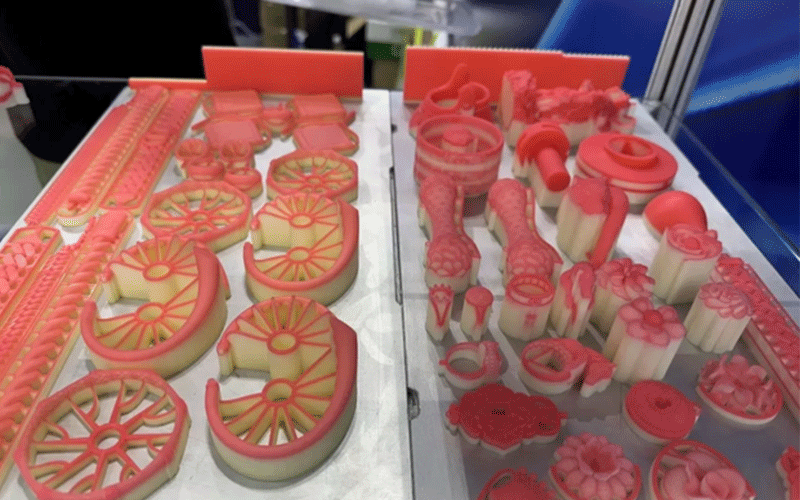
ZCZH, a China-based industrial 3D printing company, needed a more efficient and flexible approach to wax pattern production for investment casting. By integrating Xaar’s Nitrox printheads into its wax-jetting system, the company has enabled a fully digital additive manufacturing process. This approach reduces lead times from days to hours, improves accuracy and supports small-batch, complex production, helping casting manufacturers modernise workflows and increase production agility.
The client profile
ZCZH is an industrial 3D printing specialist developing advanced manufacturing systems for precision applications. The company focuses on delivering digital production technologies that replace traditional, labour-intensive processes. Its solutions are designed for sectors such as aerospace, automotive, medical devices and industrial equipment, where precision, repeatability and operational efficiency are vital.
The project
Wax pattern production is a critical stage in investment casting, directly impacting accuracy, surface quality and efficiency. Traditional methods rely on manual engraving and tooling, which are
time-consuming and difficult to modify, particularly for complex or low-volume parts. As demand grows for faster product development and increased design flexibility, casting manufacturers require more agile production methods.
ZCZH set out to digitise wax pattern production, replacing conventional workflows with an additive manufacturing approach. The goal was to enable rapid iteration, reduce dependency on tooling and support small-batch, high-complexity production while maintaining the precision required for industrial casting applications.
The solution
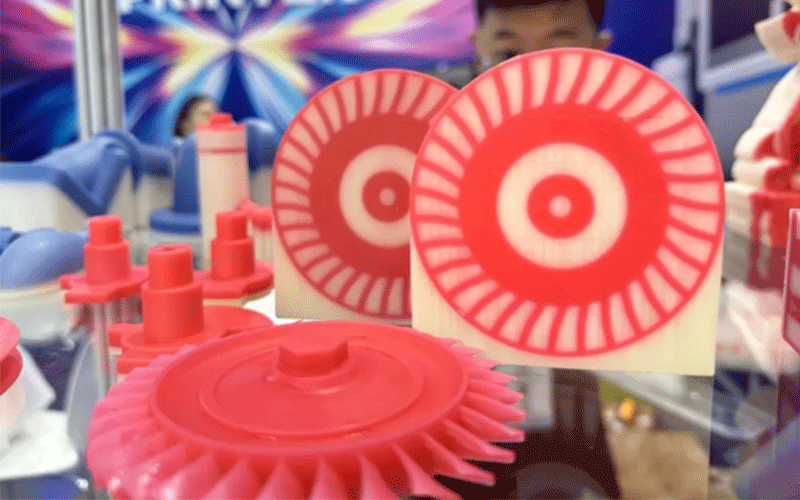
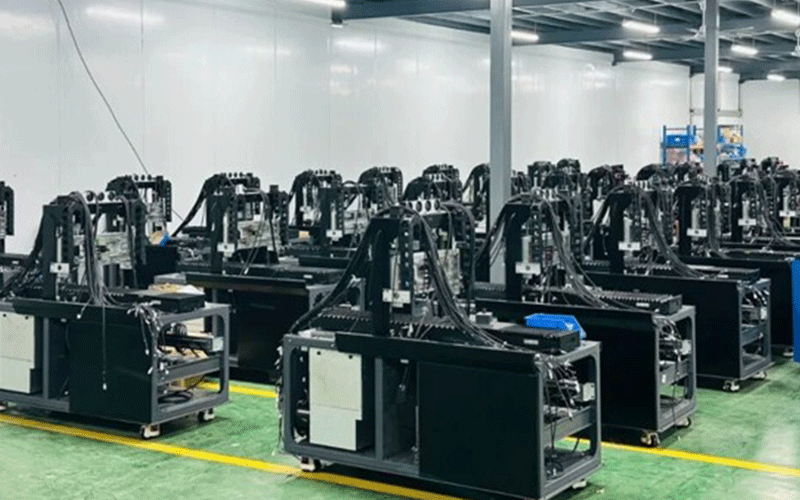
ZCZH developed a wax-jetting 3D printing system powered by Xaar’s Nitrox printheads. At the core of the solution is inkjet-based deposition of wax materials, supported by TF Technology and the SureFlow fluid management system. These technologies enable continuous ink recirculation behind the nozzles, preventing sedimentation and reducing clogging risks, which is essential for reliable wax jetting.
The printhead architecture supports stable jetting of higher viscosity fluids while maintaining precise droplet control. This ensures consistent wax deposition across complex geometries, delivering high accuracy and repeatability. Ultra High Viscosity Technology further enhances performance by enabling effective handling of challenging materials, while controlled temperature management ensures stable operation in production environments.
The implementation
The wax-jetting system was integrated into ZCZH’s additive manufacturing platform as a fully digital workflow, directly linking 3D design data to production. This eliminated multiple manual steps and reduced the need for post-processing.
By adopting an inkjet-based approach, the system enabled straightforward onboarding for operators familiar with digital manufacturing tools. The transition from conventional tooling to digital production required process adaptation, but the simplified workflow reduced operational complexity over time. The result is a scalable and repeatable production method suited to industrial environments.
The impact
Outcome 1
Production cycles reduced from days to hours, enabling faster development and iteration
Outcome 2
Improved accuracy and repeatability with consistent micron-level precision
Outcome 3
Greater flexibility through tool-free production, supporting small-batch and complex parts
Wax pattern production places very specific demands on accuracy, repeatability and production stability. This project demonstrates how industrial inkjet can be used as a reliable manufacturing process rather than a prototyping tool. By combining precise droplet control with stable, long‑duration jetting, inkjet enables manufacturers to digitise complex workflows and achieve consistent
results at industrial scale.
Samual Tam
General Manager Xaar Asia
Technical highlights
Key capabilities
• High-viscosity fluid jetting
• Continuous ink recirculation with
TF Technology
• Precise droplet control for complex
geometries
Compatibility points
• Integrated with additive manufacturing
workflows
• Supports temperature-controlled wax
materials
• Suitable for industrial production
environments
Deployment notes
• Deployed within ZCZH wax-jetting 3D
printing systems for precision casting
applications
The future
The adoption of digital wax-jetting opens up further opportunities for expanding additive manufacturing in casting applications. Continued development is expected to focus on enhancing throughput, material compatibility and deployment across additional sectors requiring high-precision components.