

GS1 Sunrise 2027 FAQs: What Packaging Manufacturers Need to Know
- Categories:
- Digital Inkjet ,
- Printheads ,
- Labels ,
- Corrugate
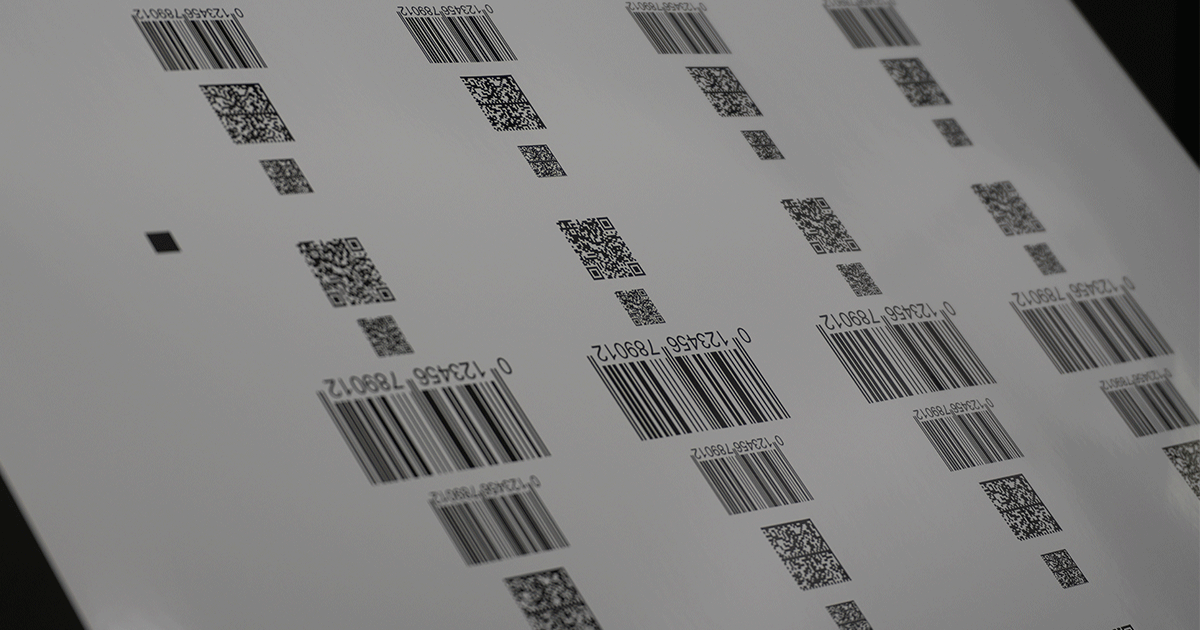
As Tesco becomes the first UK supermarket to transition an entire product range to QR codes, the interest in, and momentum behind, GS1 Sunrise 2027 grows. And with this momentum comes a series of practical questions.
What exactly is GS1 Sunrise? Is it a legal requirement? Will 1D barcodes disappear? What information needs to be included in a 2D code? Can existing print technology deliver the quality and speed required? And what does all of this mean for packaging, labels and high-speed production environments?
Below, we answer some of the most frequently asked questions around GS1 Sunrise 2027 and explore how Xaar’s inkjet technologies, including the Xaar Versatex Printbar and Xaar Aquinox, can help packaging manufacturers prepare for the next generation of coding and marking.
What is GS1?
GS1 is a global standards organisation that develops and maintains standards for product identification and data sharing, including barcodes, 2D codes, EDI, RFID tags and global identifiers such as GTINs, GLNs and SSCCs. Its standards are designed to help product data be identified and shared consistently worldwide across retailers, wholesalers, manufacturers and logistics providers.
In packaging, GS1 standards are generally associated with product and logistics codes. These include EAN and UPC barcodes for retail, GS1-128 for logistics and distribution and GS1 DataMatrix or GS1 QR codes for richer, more flexible product data.
What is GS1 Sunrise 2027?
GS1 Sunrise 2027 is a global initiative to enable 2D barcodes at retail point of sale by the end of 2027. GS1 states that, by the end of 2027, all retail point-of-sale systems should be capable of reading and processing a defined set of GS1 2D barcodes, alongside existing linear barcodes.
In simple terms, the ambition is to move beyond barcodes that primarily identify a product for price lookup and towards 2D codes that can carry or connect to richer product information.
However, GS1 Sunrise 2027 is not a government regulation and it does not mean that every 1D barcode will instantly disappear. Rather than a legal imperative, 2027 is an industry-led target, and 1D and 2D codes are expected to coexist over an indeterminate transition period.
Why is the industry moving from 1D to 2D codes?
The main driver is data. A traditional 1D barcode can identify a product, but it can only hold a limited amount of information. As more data is required, a 1D barcode becomes longer and takes up more packaging space. This creates a challenge for FMCG brands and packaging designers, where there is constant pressure to balance regulatory, retail and brand communication considerations.
For manufacturers selling within the EU, Digital Product Passports (DPPs) represent another data obligation. Designed to support traceability and to provide greater information to stakeholders, DPPs are required to include a broad raft of information and must be accessible via machine-scannable code on-product. The amount of data which legally must be included makes a traditional 1D barcode impractical, furthering the need for an alternative solution.
2D codes, including GS1 QR codes and GS1 DataMatrix codes, can carry more information within a much smaller footprint. This enables brands and retailers to include or access information such as best-before dates, batch details, serial numbers, product provenance, digital product information and consumer-facing content, while reducing the space needed for coding on pack.
The benefits go beyond the pack itself. Better data can support faster receiving, improved inventory management, stronger traceability, more efficient recalls, anti-counterfeit measures and product authentication. GS1 Digital Link can also connect a physical product to online content, allowing consumers to access product information, promotions, provenance content or recycling guidance through a single scan.
What are the benefits of GS1 2D codes?
So, for brands, GS1 2D codes can unlock new ways to share information and interact with consumers, and for retailers 2D codes can support better traceability, inventory management and stock rotation.
What then, are the opportunities for packaging manufacturers and converters? As brands prepare for GS1 Sunrise 2027, they will require print partners with the technology, workflow capability and production understanding to deliver high quality, scannable 2D codes at industrial speed.
This creates an opportunity for packaging manufacturers to add value through compliant coding, late-stage customisation, serialisation and traceability-ready packaging.
What does GS1 Sunrise mean for packaging manufacturers?
GS1 Sunrise 2027 makes code quality, data handling and print performance more important than ever. A 2D code must be readable quickly and consistently, whether it is scanned at point of sale, in a warehouse, on a production line or by a consumer using a smartphone. If a code does not scan reliably, the result can be manual intervention, retailer friction, rejected products or wider supply chain disruption.
Packaging manufacturers will therefore need to look closely at whether their current printing processes are suitable for GS1 2D codes. The move from 1D to 2D raises questions around cell size, data content, package real estate, product shape, printhead positioning and verification. Consequently, packaging specialists need to consider repercussions beyond artwork – how the codes will be generated and verified, how variable data will be managed, and substrate suitability to name a few.
What are the main printing challenges with GS1 2D codes?
Printing GS1 2D codes is more demanding than printing simple human-readable best-before dates or batch codes. A human can often interpret a dotty or imperfect alphanumeric code, but a scanner needs clean, consistent contrast and precise code structure.
Where continuous inkjet has historically been used for best-before dates and lot numbers, the quality needed for QR codes and DataMatrix codes creates different requirements. Manufacturers need technology that can deliver quality without compromising throughput, balancing speed and throw distance to achieve the performance necessary for contemporary and future coding and marking applications.
This is where drop on demand inkjet presents a more appropriate option, as better resolution and print quality are achieved versus continuous inkjet, making it more suitable for printing high-quality 2D scannable codes.
This is particularly important where packaging is moving at speed, where throw distance varies or where substrates are not perfectly positioned. Xaar’s drop on demand printheads such as the Aquinox and Nitrox offer larger drop size, allowing for high speed and high throw distance, improving drop placement and supporting better code quality even where boxes may not always sit in exactly the same position on the line.
How can Xaar help with GS1 Sunrise readiness?
Xaar’s inkjet technologies are designed to support high-quality coding and marking, including variable data, 1D and 2D barcodes, batch codes, serialised information and traceability codes.
For GS1-related applications, Xaar’s key strength lies in the ability to combine speed, quality and reliability. Whether it’s primary or secondary packaging, Xaar’s inkjet printheads are able to print 2D codes at speed with the resolution required for reliably successful scanning.
For packaging providers looking to add variable data printing to existing analogue label lines, Xaar’s Versatex Black printbar offers the ideal solution. Able to print 1D and 2D barcodes as well as human-readable codes, Versatex Black is a ‘plug and play’ printbar which delivers serialisation, personalisation, authentication codes and supply chain tracking all at production speeds. Suitable for both analogue label presses and finishing lines it can handle web widths of 430mm and line speeds of up to 75m/min.
Versatex also represents the opportunity to deliver advanced print capability for high-value primary pack applications which require high-quality coding and traceability, for example pharmaceutical top sheets, medical device packaging and surgical supply packaging.
For secondary packaging applications, including cardboard and corrugated substrates, Xaar’s Aquinox offers an effective solution for coding and marking using aqueous inks. Engineered for reliability and productivity, Aquinox offers a high native resolution of 720npi, which allows for printing at speeds of more than 250m/min depending on application. With its high productivity print mode (also available across all Xaar printheads) and the ability to jet at distances of over 10mm combine with Xaar’s Ultra High Viscosity, High Laydown & TF Technology to deliver the speed and quality needed.
For GS1 and 2D coding, Grade 4 2D codes can be achieved on uncoated white corrugate with Aquinox’s aqueous compatibility, high productivity and incorporation of Xaar’s technologies translating to dependably sharp print quality across high-speed industrial lines.
What should packaging manufacturers do now?
For packaging manufacturers, now is the perfect time to assess coding and marking capabilities and to make appropriate upgrades, before 2D codes transition from a nice-to-have to a retailer non-negotiable.
By considering whether current print technology can deliver the required print quality at production speed, manufacturers can begin the transition now, utilising a ‘crawl, walk, run’ approach rather than a last-minute dash for compliance down the line.
It’s also worth consulting with brand owners, retailers and OEMs sooner rather than later to understand trading partner timelines, code requirements, verification expectations and data workflows. The move to GS1 2D codes involves much more than changing a printed symbol – data structure, code generation, print quality, substrate performance, line speed and verification all need to work together.
Preparing for the future of packaging traceability
For packaging manufacturers, GS1 creates both responsibility and opportunity. Those that can deliver reliable, high quality, GS1-ready 2D codes at production speed will be well placed to support customers as the retail landscape evolves.
In order to effectively achieve this, manufacturers need to consider drop on demand inkjet as more than a premium alternative to traditional coding technologies, but as a leading technology for high speed, high accuracy applications such as 2D code printing.
With technologies including Xaar Versatex Printbar and Xaar Aquinox, Xaar is helping manufacturers and converters meet the demands of GS1 Sunrise 2027 while building more flexible, data-rich and future-ready print capability.